

Everything You Need to Know About the A Level Grading System in Singapore
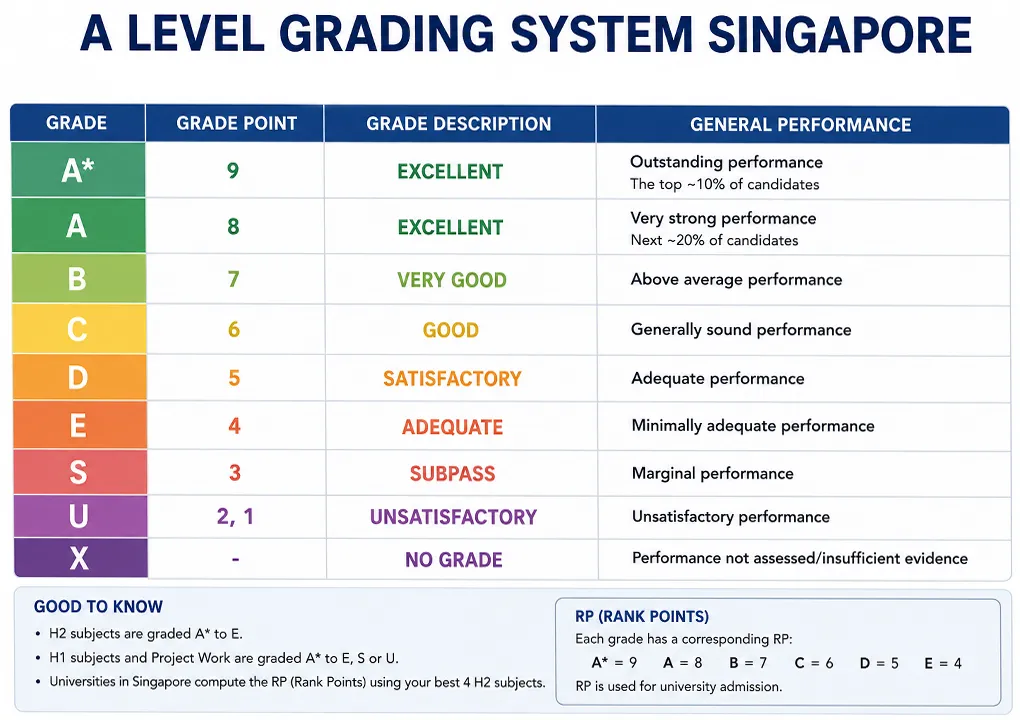
The A Level Grading System plays a crucial role in determining university admissions, scholarship opportunities, and future academic pathways for students in Singapore. Understanding how grades are awarded and how rank points are calculated allows students to plan their academic goals more effectively during their Junior College education.
Singapore’s GCE A-Level examination is recognised internationally for its academic rigour and serves as the primary qualification for entry into local universities such as the National University of Singapore, Nanyang Technological University, and Singapore Management University. As competition for university placements remains strong, a clear understanding of the grading framework becomes increasingly important.
The A Level Grading System in Singapore uses grades ranging from A to U, with each grade assigned specific points for Rank Point calculations. The system supports university admissions by providing a standardised measure of academic performance across all candidates.
Understanding the GCE A Level Grading System
The GCE A Level grading system in Singapore assesses students based on their performance in individual subjects. Grades are awarded according to examination results and are used to calculate a student’s overall Rank Points (RP).
The grading framework is designed to evaluate both subject mastery and academic readiness for higher education. Students typically take a combination of H1, H2, and H3 subjects, along with General Paper and Project Work depending on the curriculum structure.
Each subject contributes toward the final university admission score, making consistent performance across all subjects essential.
MOE A Level Grading System Singapore
The MOE A-Level grading system follows a grade-point structure that converts examination results into numerical values used for Rank Point calculations, enabling standardized comparison of academic performance for university admissions in Singapore.
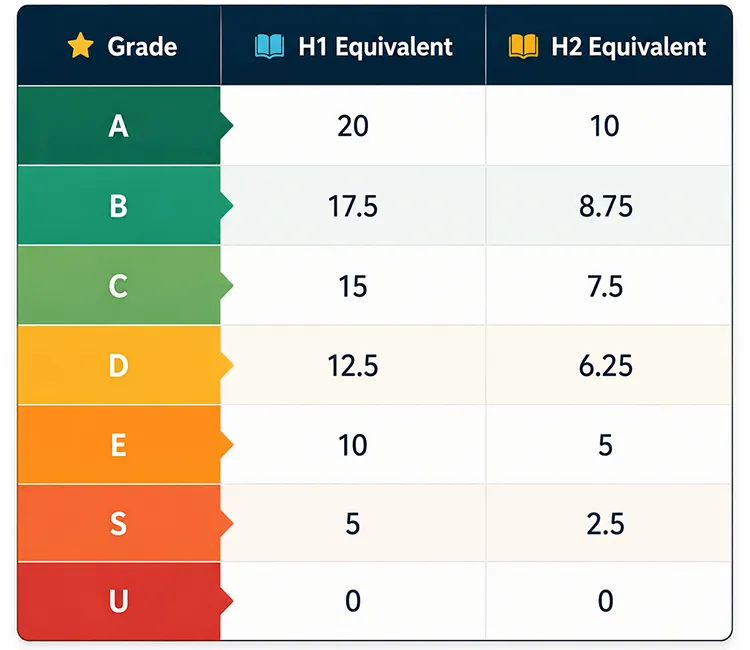
For H1 and H2 subjects, grades are awarded as follows:
| Grade | Grade Point |
| A | 20 |
| B | 17.5 |
| C | 15 |
| D | 12.5 |
| E | 10 |
| S | 5 |
| U | 0 |
A grade of A reflects excellent performance and contributes the highest points toward university admissions, significantly strengthening a student’s academic profile and overall application competitiveness.
The grading system encourages students to achieve strong results across multiple subjects rather than relying on performance in a single discipline.
Singapore Grading System and Rank Points
The Singapore grading system for A Levels incorporates Rank Points as a key measure for university admissions, allowing institutions to assess academic performance consistently by converting subject grades into a standardized score used during the selection process.
Rank Points are calculated based on a student’s performance in their content-based subjects and compulsory subjects. The maximum attainable score is 90 Rank Points.
A higher Rank Point score generally increases competitiveness for admission into highly sought-after university programmes such as medicine, law, dentistry, computing, engineering, and business.
Because admission requirements vary across institutions and programmes, students often aim to maximise their Rank Point performance to expand their available options.
A Level School Grading System Singapore
The A Level school grading system Singapore is used consistently across Junior Colleges and centralised institutions offering the GCE A-Level curriculum.
While schools may conduct internal examinations, common tests, and promotional assessments throughout the academic year, the national A-Level examination remains the most significant assessment.
Internal school examinations help students monitor progress, identify weaknesses, and prepare for the national examinations.
Teachers often use school-based assessments as indicators of readiness while helping students develop examination techniques and content mastery.
National Examinations' Grading System Singapore
The National Examinations’ Grading System Singapore is designed to maintain fairness, consistency, and academic standards across all candidates.
National examinations are administered under strict assessment guidelines to ensure reliability and comparability between examination cohorts.
The grading framework allows universities and employers to evaluate academic performance using a recognised national benchmark.
Singapore’s examination system has earned international recognition for its strong academic standards and emphasis on critical thinking, analytical reasoning, and subject mastery.
How A-Level Results Affect University Admissions
A-Level results significantly influence admission opportunities at local and international universities, as they serve as an important indicator of academic achievement and readiness for higher education, helping institutions evaluate applicants for competitive degree programmes.
Universities evaluate applicants based on Rank Points, subject prerequisites, portfolio achievements, interviews, and other admission criteria where applicable.
Competitive programmes often require exceptionally strong academic performance because of limited intake capacity, ensuring only the most qualified candidates are selected for admission.
Students aiming for selective courses should focus on maintaining consistent performance throughout Junior College while preparing strategically for national examinations.
Understanding the A Level Grading System helps students set realistic goals and develop effective academic plans.
Common Misconceptions About the A Level Grading System
Many students mistakenly believe that a single weak subject automatically prevents university admission. In reality, universities assess applicants holistically while considering overall Rank Point performance and programme-specific requirements.
Another misconception is that only H2 subjects matter. While H2 subjects contribute significantly to Rank Points, performance in H1 subjects and compulsory components can also influence overall results.
Students often benefit from focusing on balanced academic development rather than concentrating solely on selected subjects.
How Students Can Improve A-Level Performance
Success in the A-Level examinations requires strong subject mastery, effective revision techniques, and consistent practice, helping students build confidence, improve performance, and achieve their academic goals.
Students who develop structured study schedules, review concepts regularly, and complete examination-style questions often achieve stronger outcomes. Seeking academic support through consultations, study groups, or tuition programmes can also help address learning gaps before examinations.
Early preparation remains one of the most effective ways to improve performance and reduce examination stress, allowing students to build strong subject knowledge, reinforce key concepts, and develop confidence through consistent practice and structured revision.
Conclusion
The A Level Grading System serves as a fundamental component of Singapore’s education framework, providing a structured and internationally recognised method for assessing academic achievement. Understanding the GCE A Level grading system, the MOE A Level grading system, and the broader Singapore grading system helps students make informed academic decisions throughout their Junior College journey.
By understanding how grades contribute to Rank Points and university admissions, students can establish realistic goals, strengthen examination preparation, and improve their readiness for higher education opportunities. Strong academic planning, consistent effort, and a clear understanding of assessment requirements remain key factors in achieving successful A-Level outcomes.
Frequently Asked Questions
The grading scale ranges from A, B, C, D, E, S, to U, with each grade contributing a specific number of points toward Rank Point calculations.
The GCE A Level grading system assesses students using national examinations and converts grades into points used for university admissions.
The MOE framework assigns grade points to individual subjects, which are then used to calculate a student’s overall Rank Point score.
The maximum attainable Rank Point score is 90.
The grading system determines university admission competitiveness, scholarship eligibility, and access to various higher education pathways.