

O-Level Grading System in Singapore for Students and Parents

The o level grading system is a core part of Singapore’s education framework and plays a major role in determining a student’s post-secondary options. From Junior Colleges to Polytechnics, admission decisions are closely tied to how students perform under Singapore’s O-Level grading system.
For many students and parents, confusion arises around how marks become grades, how moderation works, and how to correctly interpret results. This guide explains the o level grading system in Singapore in detail, including grading criteria, the o level marking system, result interpretation, and important timelines such as the o level results release date 2026.
What is the GCE O-Level Examination?
The General Certificate of Education Ordinary Level, commonly referred to as the O-Level, is a national examination taken by secondary school students in Singapore, usually at the end of Secondary 4 or Secondary 5. The GCE o level grading system is designed to measure subject mastery, critical thinking, and application of knowledge rather than rote memorisation.
Subjects tested under the o level grade system include English, Mathematics, Sciences, and Humanities. Performance in these subjects forms the basis of a student’s o level results, which are later used for placement into Junior Colleges, Polytechnics, or other educational pathways.
Because the examination follows a national standard, Singapore’s o level grading system is widely recognised for its consistency and reliability. Understanding how the system works helps students plan realistically and reduces unnecessary stress during results season. In Singapore, the examinations are administered by the Singapore Examinations and Assessment Board (SEAB), ensuring a standardized and fair assessment across schools.
Understanding The O-Level Grading System in Singapore

The o level grading system in Singapore uses grades ranging from A1 to F9. Each grade reflects a student’s overall performance after marking and moderation. While official grade boundaries are not publicly fixed, commonly accepted mark ranges are often used to help students understand expectations.
GCE O-Level Grading Table:
| Grade | Marks Percentage (%) | Grade Point | Description | Performance Level |
|---|---|---|---|---|
| A1 | 75%–100% | 1 | Excellent | Outstanding |
| A2 | 70%–74% | 2 | Very Good | Strong mastery |
| B3 | 65%–69% | 3 | Good | Above average |
| B4 | 60%–64% | 4 | Good | Competent |
| C5 | 55%–59% | 5 | Satisfactory | Average |
| C6 | 50%–54% | 6 | Satisfactory | Basic understanding |
| D7 | 45%–49% | 7 | Weak | Limited understanding |
| E8 | 40%–44% | 8 | Very Weak | Poor understanding |
| F9 | Below 40% | 9 | Fail | Insufficient |
Students should:
- Understand what each grade means under the o level grade system
- Check which subjects are included in admission calculations
- Focus on total performance rather than a single subject
This table helps students understand the o level score range in practical terms and how raw marks typically translate into grades under the o level grading system.
O-Level Marking System vs O-Level Scoring System
The o level marking system and o level scoring system are closely related but serve different purposes. The marking system focuses on how exam papers are assessed. Examiners follow detailed marking schemes to award marks based on accuracy, working steps, and clarity of answers.
The o level scoring system, however, refers to how these marks are converted into final grades such as A1, B3, or C6. This process includes moderation to ensure fairness and consistency across different exam papers and cohorts.
Because exam difficulty can vary slightly each year, moderation helps maintain stable academic standards. This distinction is an important part of the gce o level grading system and explains why a specific mark does not always guarantee the same grade every year.
O-Level Point System and Overall Assessment
The O-Level point system is used to evaluate a student’s overall academic performance for post-secondary admission in Singapore. Instead of looking at individual subject grades in isolation, institutions assess students based on a combined point score.

How the O-Level Point System Works?
While the grading table explains individual subject performance, admission decisions in Singapore are mainly based on the O-Level point system. Under this system, grades from selected subjects are converted into points and added together to form a total aggregate score.
A key feature of the O-Level scoring system is that lower total points indicate stronger academic performance. This standardised approach allows Junior Colleges, Polytechnics, and other institutions to compare students fairly, rather than relying on individual subject grades alone. Understanding how the point system works helps students set realistic academic targets and make informed subject choices.
Key Aggregate Systems for Post-Secondary Education
Under Singapore’s O-Level grading system, different aggregate scoring systems are used depending on the post-secondary pathway chosen. These systems combine grades from selected subjects to calculate an overall score for admission decisions.
- L1R5 (Junior College – JC): Used for JC admission, L1R5 includes one language subject (L1) and five relevant subjects (R5). Students with lower L1R5 scores generally have a higher chance of entering more competitive Junior Colleges, as this system reflects overall academic strength across a broad range of subjects.
- L1R4 (Millennia Institute – MI): L1R4 is used for Millennia Institute and some alternative pathways. It includes one language subject and four relevant subjects, allowing students with a smaller subject combination to qualify for post-secondary education.
- ELR2B2 (Polytechnic Admission): ELR2B2 is commonly used for Polytechnic courses. It focuses on English Language, two course-relevant subjects, and two best-performing subjects, reflecting the specialised and practical nature of Polytechnic education.
Bonus Points in the O-Level Admission System
In addition to aggregate scores, eligible students may receive bonus points that are deducted from their total aggregate score, improving their chances of admission to competitive institutions.
Bonus points are most commonly awarded for Co-Curricular Activities (CCA) excellence and, in some cases, for taking Higher Mother Tongue when applying to Junior Colleges. Typically, students can earn up to four bonus points. While bonus points do not affect subject grades, they can make a meaningful difference in final admission outcomes.
How Grades Convert into Points in the O-Level System?
Under the o level point system, each subject grade is assigned a numerical value that contributes to a student’s total aggregate score. In general, A1 and A2 carry the lowest point values, while weaker grades such as D7, E8, and F9 contribute higher points. This means that lower overall points indicate stronger academic performance.
For example, students aiming for Junior College admission typically use the L1R5 system, where grades from six subjects are combined to form a total score. A student with multiple A1 or A2 grades will have a much lower aggregate score than one with several lower grades. This conversion process is a key part of the o level scoring system and explains why students are encouraged to aim for consistency across subjects rather than focusing on a single paper.
How Does the Bell Curve Work in O-Level?
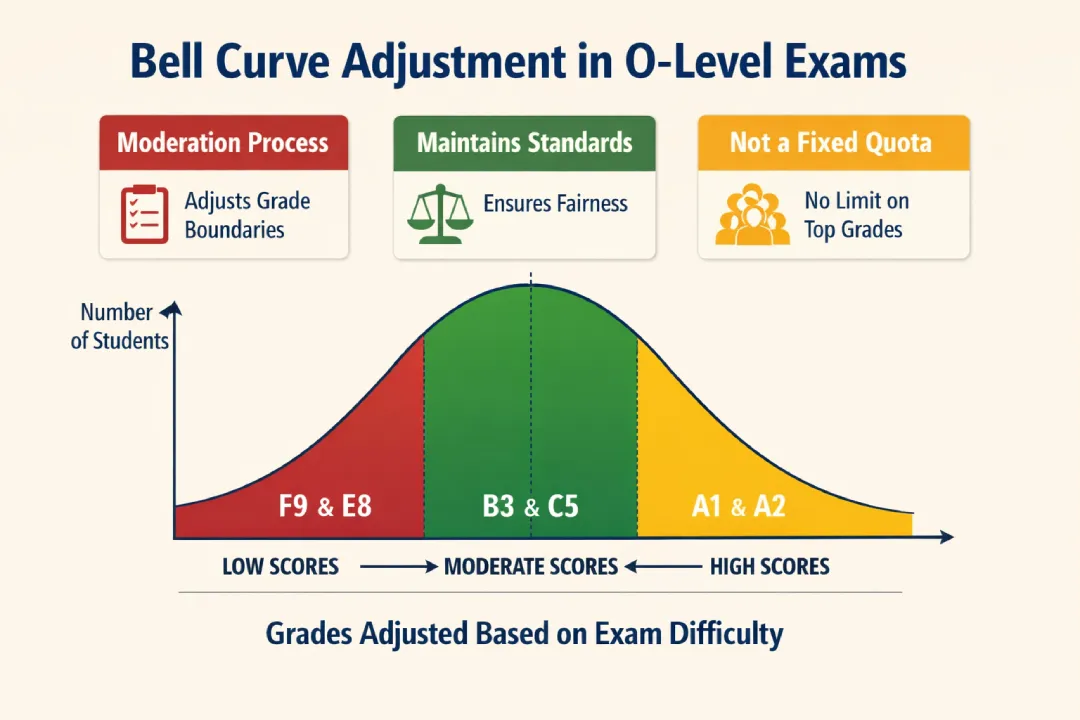
The phrase “bell curve” is often misunderstood. So, how does bell curve work o level examinations? In practice, O-Levels do not follow a strict bell curve where only a fixed number of students can achieve top grades.
Instead, moderation adjusts grade boundaries slightly to maintain consistent standards across years. This ensures fairness even when exam difficulty varies. Understanding this helps students focus on their own preparation rather than worrying about competition, reinforcing trust in the o level grading system.
O-Level Results Release Date 2026
The o level results release date 2026 is expected to be in January, based on previous examination cycles. While the official date is announced closer to the time, students should prepare early.
Before results day, students are encouraged to research post-secondary options, understand admission requirements, and discuss plans with parents or teachers. Being prepared allows quicker decision-making once o level results are released.
Final Thoughts
Understanding the o level grading system is essential for students and parents navigating Singapore’s education pathway. From knowing how grades are awarded to understanding estimated mark ranges and result interpretation, clarity reduces unnecessary stress and helps families make informed decisions.
The o level grading system in Singapore is designed to be fair, consistent, and reflective of a student’s overall academic performance. Rather than focusing solely on raw marks, students should look at their results holistically, taking into account subject strengths, improvement areas, and future goals. A single grade does not define a student’s potential or limit their opportunities.
Frequently Asked Questions
O-Level scoring works by converting moderated exam marks into grades, which are then translated into points for admission purposes.
Check individual subject grades, convert them into points if required, and calculate the total score based on L1R5 or L1R4.
The O-Level results release date 2026 is expected to fall in January, based on previous years’ timelines.
The best score under the o level grading system is the lowest possible total when grades are considered together for admission. For example, achieving multiple A1 or A2 grades results in a strong overall outcome. However, the “best” score depends on a student’s intended pathway, as different Junior Colleges and Polytechnics have different cut-off requirements.
There is no strict bell curve. Grades are moderated to maintain consistent standards, not to limit the number of top scorers.