

MOE Math Syllabus Singapore for Primary and Secondary Students
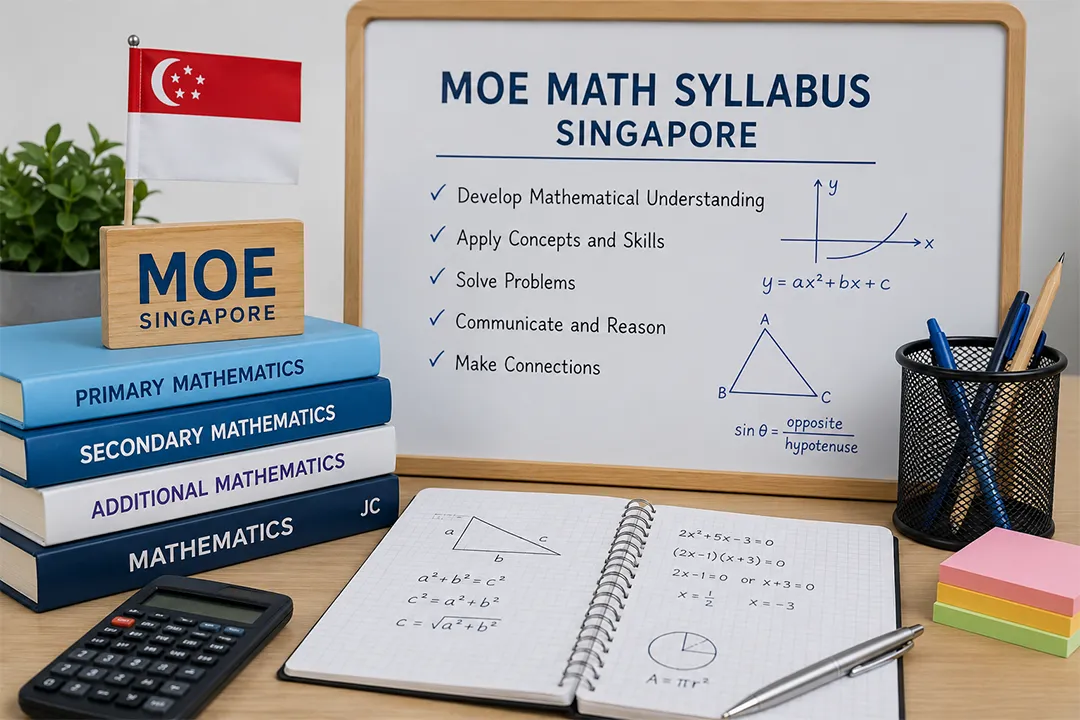
Mathematics plays a vital role in every student’s academic journey in Singapore. More importantly, the MOE Math Syllabus provides a structured framework that helps students develop logical thinking, analytical reasoning, and practical problem-solving skills from an early age. Rather than focusing solely on calculations, the syllabus encourages learners to understand mathematical concepts and apply them confidently in everyday situations.
As students progress from primary to secondary school, the complexity of mathematical concepts increases gradually. Therefore, parents who understand the syllabus can better support their children’s learning, while students can prepare more effectively for school assessments and national examinations. Whether your child is beginning Primary 1 or preparing for the GCE O-Level examinations, understanding the curriculum offers valuable insight into what lies ahead.
What Is the MOE Math Syllabus?
The MOE Math Syllabus is designed by Singapore’s Ministry of Education to provide a structured and consistent mathematics education for students across all government and government-aided schools. It builds mathematical knowledge progressively while emphasising conceptual understanding instead of memorisation, helping students solve problems with greater confidence.
The syllabus also encourages logical reasoning, clear communication, and the exploration of different solution methods. Regular updates ensure it remains relevant to modern educational needs, equipping students with essential mathematical and critical thinking skills for lifelong learning.
MOE Math Syllabus Primary: Building Strong Foundations
The moe math syllabus primary introduces young learners to essential mathematical concepts while developing confidence through structured learning experiences. Since each topic builds upon previous knowledge, students establish a solid foundation before moving to more advanced concepts.
The curriculum places equal importance on conceptual understanding and procedural fluency. Therefore, students learn not only how to perform calculations but also why mathematical methods work.
Primary Math Syllabus
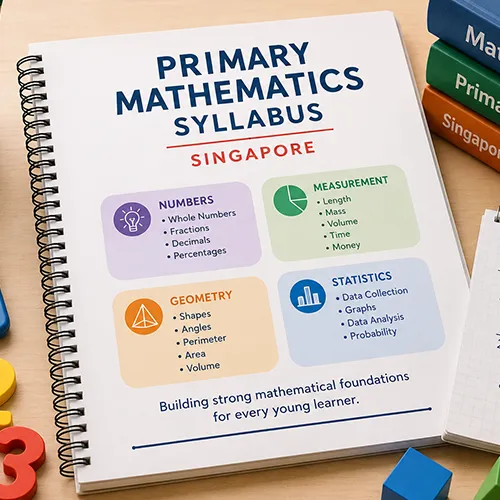
The Primary Math Syllabus (Primary 1 to 6) progresses systematically across six years, ensuring that students develop increasingly sophisticated mathematical skills.
In the lower primary years, students focus on understanding numbers and basic arithmetic. They learn addition, subtraction, multiplication, and division while becoming familiar with fractions, measurement, money, time, and simple geometry. Additionally, visual representations and hands-on activities help children grasp abstract concepts more effectively.
As students move into the upper primary levels, they encounter more complex topics. These include:
- Whole numbers and number patterns.
- Fractions, decimals, and percentages.
- Ratio and proportion.
- Speed.
- Area, perimeter, and volume.
- Angles and geometry.
- Data analysis.
- Basic algebraic thinking.
Furthermore, problem-solving becomes increasingly important throughout Primary 5 and Primary 6. Students learn to interpret word problems, identify relevant information, and apply multiple mathematical concepts within a single question.
This gradual progression ensures that learners are well prepared for the Primary School Leaving Examination (PSLE) while developing analytical skills that support future learning.
Download MOE Math Syllabus Singapore 2026 (PDF Format)
MOE Math Syllabus Secondary: Preparing Students for Higher-Level Mathematics
After completing primary education, students transition into the moe math syllabus secondary, where mathematical thinking becomes significantly more analytical and abstract.
At this stage, students move beyond arithmetic and begin exploring relationships, patterns, formulas, and mathematical proofs. Consequently, they develop stronger reasoning skills that prepare them for upper secondary education and national examinations.
The curriculum also encourages independent learning. Rather than depending solely on teacher guidance, students learn to analyse questions carefully, plan solution strategies, and justify their answers logically.
Moreover, technology and mathematical modelling become increasingly relevant as students encounter more sophisticated applications of mathematics.
Secondary Math Syllabus
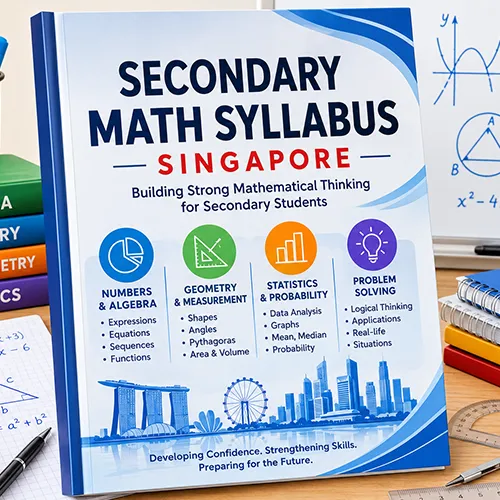
The Secondary Math Syllabus (Secondary 1 to 4/5) expands students’ mathematical knowledge while strengthening problem-solving abilities across multiple domains.
During Secondary 1 and Secondary 2, students typically study:
- Algebraic expressions.
- Linear equations.
- Geometry.
- Statistics.
- Probability.
- Graphs.
- Mensuration.
- Coordinate geometry.
These topics establish the essential knowledge required for more advanced mathematics in the upper secondary years.
As students become more comfortable with abstract reasoning, they also learn to connect different mathematical concepts. For example, algebra may be applied to geometry, while statistics may support probability problems. This integrated learning approach reflects the real-world use of mathematics across various disciplines.
Upper Secondary
As students progress to the Upper Secondary level (Sec 3–Sec 4/5 – O-Level or N-Level), the mathematics curriculum becomes more rigorous and examination-focused. Students are expected to apply concepts learned in lower secondary to solve more complex and multi-step problems, making critical thinking and logical reasoning increasingly important.
Elementary Mathematics (E-Math) covers topics such as algebra, geometry, trigonometry, statistics, probability, coordinate geometry, and mensuration. Students taking Additional Mathematics (A-Math) study more advanced concepts, including logarithms, exponential functions, differentiation, integration, and trigonometric identities, providing a strong foundation for Junior College and STEM-related courses.
Success at this level requires more than memorising formulas. Students must demonstrate clear mathematical reasoning, accurate working, and effective problem-solving skills. Regular practice, consistent revision, and structured guidance help students build confidence and perform well in their O-Level or N-Level examinations.
Why Understanding the MOE Math Syllabus Matters
Understanding the Singapore MOE Math Syllabus helps students, parents, and educators support learning more effectively. Students can focus on key concepts, plan their revision, and track their progress with greater confidence. Parents gain a better understanding of curriculum expectations, making it easier to assist with homework and identify areas that need improvement.
Tuition centres can align their lessons with the MOE curriculum, providing focused support that reinforces classroom learning. Beyond academic success, the syllabus develops critical thinking, logical reasoning, and problem-solving skills that prepare students for higher education, future careers, and everyday decision-making.
Final Thoughts
The MOE Math Syllabus provides a structured pathway that helps students build strong mathematical knowledge from primary through upper secondary levels. It focuses on developing conceptual understanding, logical reasoning, and practical problem-solving skills rather than relying solely on memorisation. This approach prepares students for national examinations and future academic success.
For parents, understanding the curriculum makes it easier to support their children’s learning and monitor their progress. Students who follow the syllabus consistently and seek help when needed can build confidence, strengthen their mathematical abilities, and develop valuable skills that benefit them throughout their education and future careers..
Frequently Asked Questions
The MOE Math Syllabus is Singapore’s official mathematics curriculum for Primary and Secondary students.
It covers numbers, fractions, decimals, geometry, measurement, data analysis, ratio, and basic algebra.
It includes algebra, geometry, trigonometry, statistics, probability, graphs, and Additional Mathematics topics.
It helps students develop logical thinking and apply mathematics to real-life situations.
Students should revise regularly, practise consistently, understand concepts, and learn from their mistakes.