

Understanding the O Level Marking System in Singapore
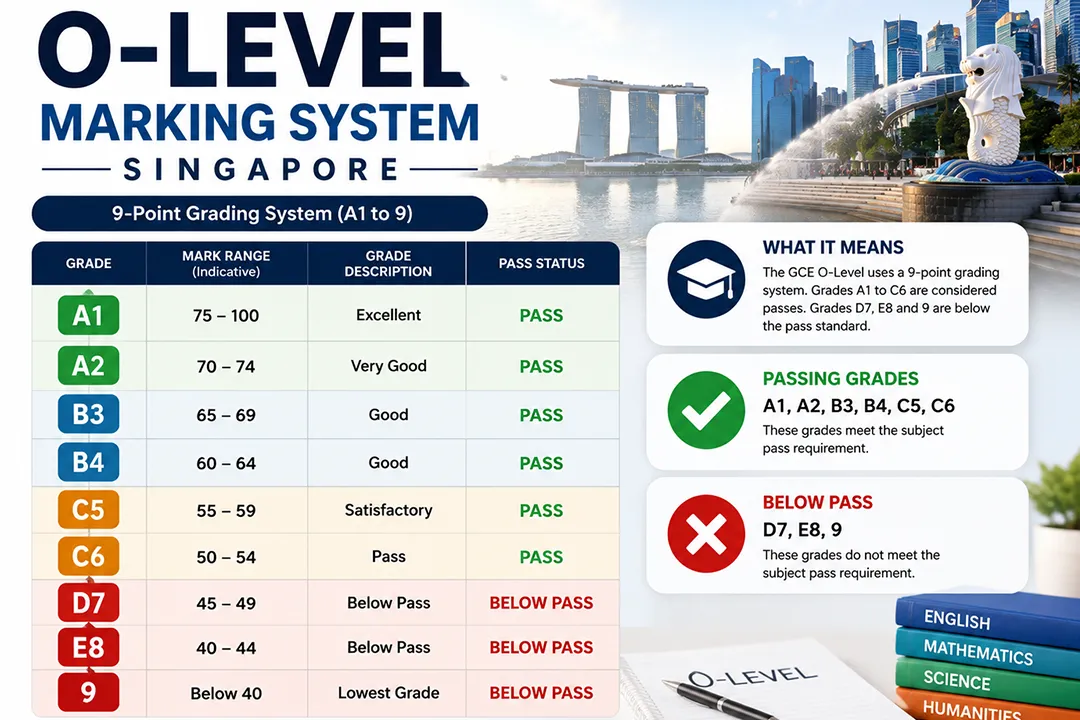
The o level marking system plays an important role in determining how students’ performance is represented in Singapore’s GCE O-Level examinations. Understanding the grading structure can help students interpret their results more accurately and make better decisions about their post-secondary education options.
The Singapore-Cambridge GCE O-Level examination is a national examination taken by school and private candidates. It is jointly administered by SEAB, the Ministry of Education and Cambridge International Education, and is closely aligned with Singapore’s school curriculum.
Although students often refer to the system as an O-Level marking or scoring system, the final result is expressed through grades rather than simply showing raw examination marks. These grades can subsequently be used for admission and aggregate calculations, depending on the educational pathway.
How Are O-Level Subjects Graded in Singapore?
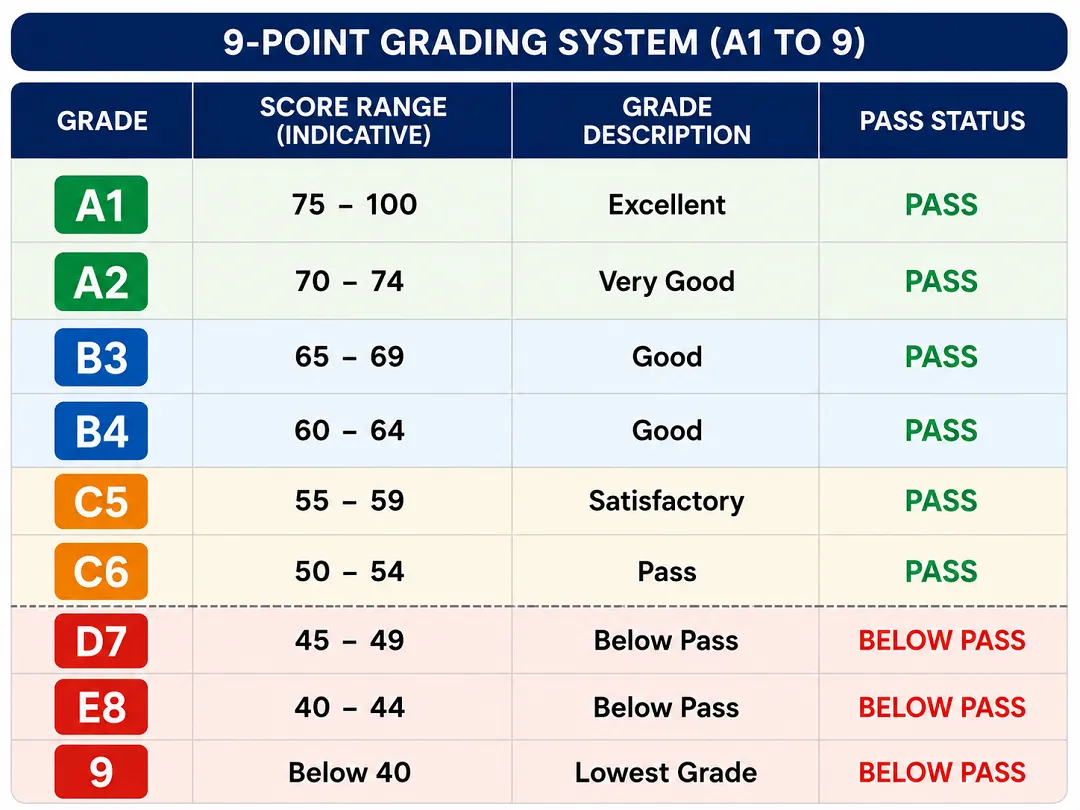
O-Level subjects are awarded grades ranging from A1 to 9. The sequence is A1, A2, B3, B4, C5, C6, D7, E8 and 9, with A1 representing the highest performance and Grade 9 the lowest. SEAB states that Grade 9 indicates that the candidate’s performance has not met the minimum requirements of the subject.
The grade awarded reflects a candidate’s overall performance in the relevant examination components for that subject. However, the precise assessment structure can differ between subjects because individual syllabuses may contain different papers, coursework elements, practical components, oral examinations, or other forms of assessment. Students should therefore refer to the official syllabus for their specific subject rather than assuming that every O-Level subject is assessed in exactly the same way.
O-Level Grading System in Singapore
The O-Level Grading System in Singapore is based on a nine-point subject grading structure. The numerical association is particularly important when students later calculate aggregate scores for different post-secondary pathways.
The commonly used grade-to-point relationship is:
| O-Level Grade | Point Value |
| A1 | 1 |
| A2 | 2 |
| B3 | 3 |
| B4 | 4 |
| C5 | 5 |
| C6 | 6 |
| D7 | 7 |
| E8 | 8 |
| 9 | 9 |
Lower point totals represent stronger performance. Therefore, a student receiving A1 grades would obtain fewer points than a student receiving B3, C5, or D7 grades when those grades are used for an applicable aggregate calculation.
What Is a Passing Grade for O-Level in Singapore?
For the GCE O-Level examination, A1 through C6 are considered subject passes, according to the Ministry of Education’s response published by SEAB in 2026. Grades D7, E8 and 9 fall below the subject-pass threshold.
However, obtaining a subject pass does not automatically mean that a student qualifies for every post-secondary course. Individual courses and admission pathways can have additional subject requirements and aggregate-score criteria. For example, students may need to pass particular subjects to qualify for certain courses, so students should distinguish between achieving a pass grade and meeting the admission requirements for a specific programme.
O Level Point System in Singapore
The o level point system singapore is especially relevant when students use their examination results for post-secondary admission calculations. Since stronger grades carry fewer points, students generally aim for lower aggregate scores when competing for courses where admission is more selective.
For example, a student with A1 in Mathematics receives 1 point for that grade, while a C6 corresponds to 6 points. Consequently, improving a subject from C6 to A1 can make a substantial difference when that subject is included in an applicable aggregate calculation.
Students should nevertheless use the correct aggregate formula for their intended pathway because not every subject is automatically included. The subjects considered and the way grades are mapped can depend on the specific admission exercise and qualification requirements.
Does a Higher O-Level Mark Mean a Higher Score?
Not necessarily. The O-Level system is structured so that stronger academic performance receives a better grade, and better grades correspond to lower numerical point values when grades are converted for applicable aggregate calculations.
For instance, A1 is academically stronger than A2, and A2 is stronger than B3. However, in an aggregate calculation, A1 contributes 1 point while B3 contributes 3 points. Therefore, students should remember that lower aggregate points are generally better, rather than assuming that a higher numerical score represents stronger performance.
O-Level Score System in Singapore
The o level score system singapore should be understood as two connected but distinct concepts: individual subject grades and aggregate scores used for progression. A student’s certificate records individual subject grades, while admission exercises may use selected subjects to calculate a separate score.
This distinction is important because a student can have several subject grades but only certain subjects may count towards a particular admission formula. Therefore, simply adding every grade on an examination certificate may not produce the relevant admission score.
Why Understanding the O-Level Marking System Matters
A clear understanding of the grading structure allows students to interpret results without confusing examination grades with admission points. It can also help them identify subjects that require improvement and understand how stronger grades may influence their future educational options.
Furthermore, knowing how grades translate into points can make academic planning more focused. Instead of looking only at whether a subject has been passed, students can consider how individual grades may affect the aggregate requirements of their intended post-secondary pathway.
How Are O-Level Marks Converted Into Grades?
The final grade for an O-Level subject is determined through the assessment requirements set for that subject rather than through a single universal percentage-to-grade table that applies to every paper. Different subjects can have different assessment components, weightings, and examination formats. Therefore, students should avoid assuming that a particular raw percentage always produces the same grade across every O-Level subject.
In practice, the examination authority applies the relevant assessment and grading procedures for each subject before issuing the final grade. This means students should focus on understanding their subject requirements and preparing consistently across all assessed components instead of relying on an unofficial marks-to-grade conversion chart.
How to Calculate O-Level Points?
Once the final grades are available, students can convert applicable grades into their corresponding point values when an aggregate calculation requires it. The basic relationship is straightforward: A1 contributes 1 point, A2 contributes 2 points, B3 contributes 3 points, and so on until Grade 9 contributes 9 points.
For example, if a student has A1, A2, B3, B4 and C5 in five subjects, the corresponding points would be 1, 2, 3, 4 and 5. Adding these values gives an aggregate of 15 points. However, this example does not mean that all five subjects would necessarily be used for a particular admission calculation.
What Is the Difference Between Grades and Aggregate Points?
An individual grade describes a student’s performance in a particular subject. Aggregate points, on the other hand, combine selected subject grades according to a specific admission formula. These two concepts are related but should not be treated as interchangeable.
Understanding this distinction can prevent common mistakes when students estimate their admission position. A student may receive strong grades across several subjects, but only the subjects that meet the relevant admission criteria will contribute to a particular aggregate. Therefore, checking the official requirements remains essential before calculating an admission score.
How Can Students Improve Their O-Level Results?
Improving O-Level performance starts with understanding the assessment requirements of each subject. Students can identify weaker topics, review mistakes systematically, practise examination-style questions, and develop time-management strategies. Regular revision is generally more effective when it focuses on understanding concepts rather than simply repeating memorised answers.
Students should also pay attention to subjects that contribute to their intended post-secondary pathway. Setting realistic grade targets can provide a clearer direction for revision and help students allocate their time more effectively. Where necessary, additional academic support can provide structured practice and explanations for difficult concepts.
Why Choose Club Math?
Club Math provides structured mathematics tuition designed to help students strengthen their understanding of mathematical concepts and develop greater confidence when approaching challenging questions. Its lessons can support students who want additional guidance alongside their regular school learning.
Through focused teaching, practice, and problem-solving activities, Club Math aims to help learners build stronger mathematical foundations rather than relying solely on memorisation. This approach can be useful for students preparing for important examinations and working towards their academic goals.
Conclusion
Understanding the o level marking system helps students interpret their grades and appreciate how those results may contribute to different post-secondary admission calculations. The system uses grades from A1 to 9, with A1 representing the strongest performance and Grade 9 the lowest.
However, students should distinguish between individual subject grades, grade-to-point conversion, and the aggregate formulas used for admission. By checking the requirements of their intended pathway and focusing on consistent preparation, students can make better-informed academic decisions and work towards stronger O-Level outcomes.
Frequently Asked Questions
A1 is the highest O-Level grade. It represents the strongest performance within the standard nine-grade structure.
Grade 9 is the lowest grade in the standard O-Level grading structure. It indicates that the candidate’s performance has not met the minimum requirements for the subject.
Yes. A1, A2, B3, B4, C5 and C6 are considered subject passes, while D7, E8 and 9 are below the subject-pass threshold.
No. Assessment components and requirements can differ between subjects. Students should refer to the official syllabus for the specific subject they are taking.
Generally, yes. When O-Level grades are converted into points for an applicable aggregate, stronger grades contribute fewer points. The relevant admission formula should always be checked for the specific pathway.