

How To Reduce Careless Mistakes in Math: A Practical Guide for Students

Careless mistakes in math are one of the most frustrating problems students face. You understand the concept. You know the method. Yet marks are lost due to small errors that seem avoidable in hindsight. For many students, this raises a troubling question: “Why do I constantly make careless mistakes even when I know the topic?”
Learning how to reduce careless mistakes in math is not about intelligence. It is about habits, mindset, exam discipline, and training the brain to slow down at the right moments. This article explains why these mistakes happen and how students can systematically eliminate them over time.
Careless mistakes in math are caused by rushing, stress, overconfidence, and poor exam habits. Students can reduce these errors through structured practice, self-checking, and improved exam discipline.
Why Careless Mistakes Happen in Math
Before discussing solutions, it is important to understand the root causes. Careless mistakes rarely occur randomly. They usually stem from predictable patterns that repeat across tests and exams.
One major cause is cognitive overload. During exams, students are processing time pressure, unfamiliar phrasing, and performance anxiety simultaneously. Even strong students may rush calculations or misread questions simply because their mental bandwidth is stretched.
Another factor is false confidence. Overconfidence can lead students to skim questions instead of reading them carefully. When a problem “looks easy,” the brain often assumes details rather than confirming them, resulting in avoidable errors.
For some students, the issue is mechanical rather than conceptual. Messy handwriting, unclear working, or skipping steps can cause sign errors, miscopied numbers, or incorrect substitutions.
Understanding why careless mistakes occur is the first step toward learning how to stop silly mistakes in maths effectively.
How to Stop Silly Mistakes in Maths Starts With Awareness
Students who reduce careless mistakes successfully share one habit: they track their errors.
Instead of simply checking whether an answer is right or wrong, they ask why it is wrong. Was it a sign error? A copied number? A forgotten unit? A misread instruction? Over time, patterns emerge.
When a student realises that 70% of mistakes come from rushing or misreading questions, the solution becomes targeted. This level of awareness transforms careless mistakes from a vague problem into a solvable one.
Rushing Through the Questions: The Silent Score Killer
Rushing through the questions is one of the most common reasons students lose marks unnecessarily. This often happens when students equate speed with intelligence or fear running out of time.
Ironically, rushing often causes more time loss. A single careless error can invalidate several steps of correct working, leading to confusion and rework.
Learning how to avoid silly mistakes in exams requires controlled pacing. Strong exam performers allocate time deliberately, slow down at key steps, and resist the urge to skip verification.
Messy Handwriting and Disorganised Working
Messy handwriting may seem harmless, but in math, clarity matters. Poorly written numbers, unclear variables, and cramped working spaces significantly increase the chance of mistakes.
When students cannot easily reread their own work, errors go unnoticed. This is especially dangerous during multi-step problems where one small slip propagates into a wrong final answer.
Improving handwriting does not mean writing beautifully. It means writing clearly enough to verify. Leaving adequate spacing, aligning numbers properly, and showing full working reduces careless mistakes dramatically.
Overconfidence: When Familiarity Becomes a Trap
Overconfidence is a subtle but powerful cause of careless mistakes. When students see a familiar question type, they may assume it follows the same structure as previous problems.
This leads to skipped steps, ignored constraints, or incorrect assumptions. Many exam questions are designed specifically to test attention to detail, not just procedural knowledge.
Students who learn how to reduce careless mistakes in math train themselves to treat every question as new, even if it looks familiar.
Stress and Anxiety Increase Careless Errors
Stress and anxiety directly affect working memory. Under pressure, the brain prioritises speed over accuracy, increasing the likelihood of careless mistakes.
This is why some students perform well in practice but make unexpected errors in exams. The issue is not knowledge but emotional regulation.
Reducing exam anxiety through consistent practice, mock exams, and structured revision helps stabilise performance. When students feel prepared, their minds are less likely to rush or freeze.
Lack of Practice Is Often the Hidden Cause
A surprising number of careless mistakes are actually practice-related. When students lack sufficient exposure to varied questions, they rely on pattern recognition instead of careful reading.
Practice builds familiarity not just with concepts, but with question traps, wording variations, and common pitfalls. The more problems a student solves thoughtfully, the fewer careless mistakes occur.
Effective practice is deliberate, reflective, and focused on accuracy rather than speed alone.
Avoiding Careless Mistakes in Math Exams Requires a Process
Students who consistently avoid careless mistakes follow a structured approach during exams.
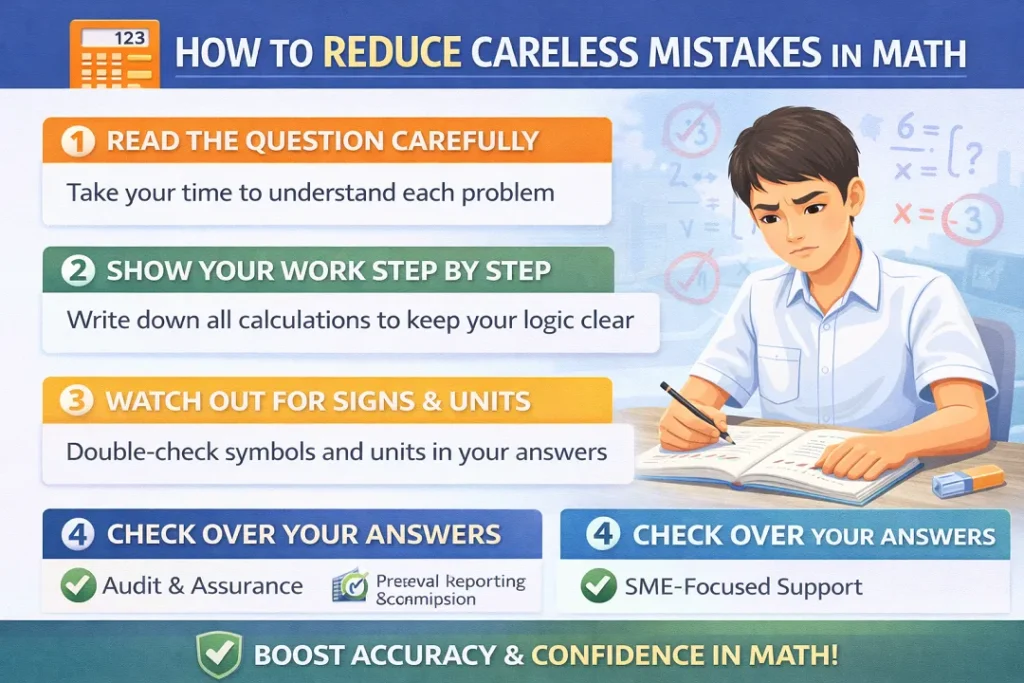
They read each question fully before writing. They underline key information mentally. They write out intermediate steps instead of jumping directly to answers. They perform quick reasonableness checks at the end.
These habits slow the student down just enough to catch errors without compromising overall timing.
How to Avoid Silly Mistakes in Exams Through Self-Checking
Self-checking is not about redoing the entire question. It is about verifying high-risk points such as signs, units, substitutions, and boundary conditions.
Students who master self-checking learn where they personally are most error-prone. For some, it is algebraic signs. For others, it is copying numbers or misreading graphs.
Targeted self-checking is one of the most effective strategies for reducing careless mistakes permanently.
Building Accuracy Is a Skill, Not a Personality Trait
Many students believe they are “just careless by nature.” This belief is harmful and incorrect.
Accuracy is a trainable skill. Just like speed or problem-solving, it improves with the right techniques, feedback, and mindset. Students who shift from blaming themselves to improving systems make steady progress.
Learning how to reduce careless mistakes in math is about building discipline, not changing personality.
Conclusion
Careless mistakes in math are not inevitable. They are predictable, identifiable, and correctable. Students who learn how to reduce careless mistakes in math develop better exam discipline, stronger confidence, and more consistent results.
By slowing down strategically, practising deliberately, managing stress, and reflecting on errors, students can turn lost marks into reliable gains. Accuracy is not talent, it is a skill built through awareness and training.
Frequently Asked Questions
Careless mistakes usually result from rushing, stress, or habitual errors rather than lack of understanding. Identifying your error patterns is key to reducing them.
Slow down at critical steps, write clearly, show full working, and practise self-checking during revision and exams.
Yes. Quality practice improves attention to detail, familiarity with question traps, and confidence under exam conditions.
Yes. Messy handwriting increases the chance of misreading numbers and skipping steps, leading to avoidable errors.
Yes. Good tuition focuses not only on concepts but also on exam techniques, accuracy training, and personalised feedback.