

Choosing Math Tuition for Primary School Students in Singapore
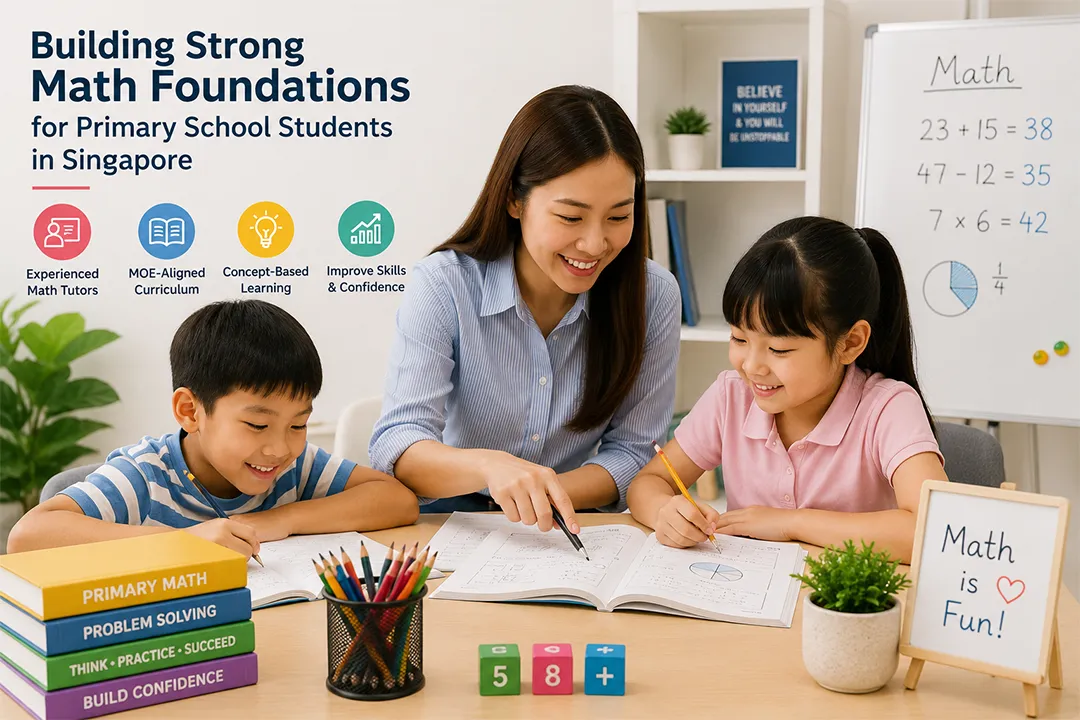
Building strong mathematical foundations during the primary years can make a significant difference to a child’s confidence and future academic progress. For families considering Math tuition for primary school Singapore, the right programme can provide additional guidance without making learning feel unnecessarily stressful.
Primary mathematics involves much more than memorising formulas or completing repetitive exercises. Students gradually develop skills in arithmetic, fractions, measurements, geometry, problem-solving, and mathematical reasoning. Therefore, additional support should help children understand how and why different methods work.
A suitable tuition programme can also complement classroom learning by giving students more opportunities to practise difficult concepts, identify mistakes, and develop greater accuracy. However, every child has different learning needs, so parents should consider teaching methods, class size, lesson structure, location, and the child’s individual goals before making a decision.
Why Do Primary School Students Need Mathematics Tuition?
Primary school mathematics introduces concepts that become progressively more challenging as students move from one level to another. A child who has difficulty understanding multiplication, fractions, or place value may encounter greater challenges when these concepts appear in more advanced problems.
Additional tuition can provide students with more time to revisit concepts that were not fully understood in school. Moreover, smaller classes can sometimes give teachers greater opportunity to identify individual weaknesses and provide targeted explanations.
However, tuition should not simply mean completing additional worksheets. Effective learning requires students to understand the reasoning behind a solution. Consequently, a good programme should combine explanation, guided practice, independent work, and opportunities to correct mistakes.
What Should Parents Look for in Math Tuition for Primary School Singapore?
Parents should first consider whether the programme matches their child’s current academic level. A student who needs help with foundational concepts may require a different approach from one preparing for demanding examination questions.
Teaching methodology is equally important. Children often respond differently to visual explanations, worked examples, practical activities, guided questioning, and repeated practice. Therefore, parents should look for a centre that can make mathematical concepts understandable rather than relying entirely on memorisation.
Class size can also influence the learning experience. Smaller groups may allow teachers to observe students more closely and address individual difficulties. At the same time, a larger class can sometimes provide opportunities for discussion and peer learning. The right choice depends on the child’s personality and learning preferences.
Where Can I Find Math Tuition in Singapore?
Parents looking for Where can I find math tuition in Singapore? have several options, including dedicated tuition centres, enrichment providers, private tutors, and small-group coaching programmes. The best option depends on the child’s requirements and the family’s preferred schedule.
Location is a practical consideration because regular attendance is essential for consistent progress. A conveniently located centre can make weekly lessons easier to maintain, particularly for younger students who may already have a busy school and extracurricular schedule.
Parents should also compare lesson frequency, class size, teaching approach, fees, curriculum alignment, and teacher experience. Rather than choosing a programme solely because it is popular, families should consider whether its learning environment is suitable for their child’s needs.
How Does Primary Math Coaching Support Young Learners?
Primary math coaching can give students more individualised attention while helping them develop better approaches to mathematical problems. Instead of immediately showing children the answer, effective coaching encourages them to identify information, select an appropriate method, and explain their reasoning.
This approach can be particularly useful for students who understand basic calculations but struggle when questions are presented in unfamiliar formats. Coaching can help them become more flexible when applying mathematical concepts.
Furthermore, regular feedback allows students to recognise recurring mistakes. Over time, they can improve calculation accuracy, develop better checking habits, and approach challenging questions with greater confidence.
How Can Tuition Improve Primary Mathematics Skills?
Consistent tuition can strengthen several areas of mathematical learning. Students may improve their numerical fluency through regular practice while developing better understanding of fractions, decimals, percentages, geometry, measurement, and problem-solving.
More importantly, structured lessons can help children recognise patterns between different topics. For example, a student who understands multiplication concepts thoroughly may find later work involving fractions, ratios, and percentages easier to approach.
Tuition can also provide an environment where mistakes become part of the learning process. When teachers explain why an answer is incorrect and guide students towards the correct reasoning, children can gradually become more independent problem-solvers.
How Important Is Problem-Solving in Primary Mathematics?
Problem-solving is one of the most important aspects of primary mathematics because students need to apply concepts rather than simply recall procedures. A child may know how to perform a calculation but still struggle to determine which operation a word problem requires.
Good tuition therefore gives students opportunities to interpret information, identify relevant details, organise their thinking, and choose suitable strategies. These skills can become increasingly important as questions become more complex.
Additionally, students should learn to explain their reasoning clearly. Understanding the process behind an answer helps develop mathematical confidence and makes it easier for teachers to identify where a misunderstanding has occurred.

How Should Parents Choose the Right Tuition Programme?
Parents should begin by identifying the child’s primary need. Some students require foundational support, while others need more challenging questions to develop higher-order problem-solving skills. Others may simply need additional practice to improve speed and accuracy.
The next step is to consider the teaching environment. Parents can ask about class sizes, lesson duration, curriculum coverage, homework, progress monitoring, and opportunities for individual feedback.
It is also worth considering the child’s attitude towards tuition. A programme that creates excessive pressure may make mathematics more difficult emotionally, even if the academic content is appropriate. A supportive environment can encourage children to ask questions and develop a more positive relationship with the subject.
Should Primary Students Attend Tuition Every Week?
Regular lessons can be beneficial because mathematics depends heavily on continuity. Weekly practice gives students opportunities to reinforce recently learned concepts before they are forgotten.
However, the ideal frequency depends on the child’s needs. A student who is coping well at school may not require several tuition sessions each week, while a child with significant learning gaps may benefit from more structured support.
Parents should also protect time for rest, play, schoolwork, and other activities. Tuition should complement a child’s education rather than overwhelm the weekly schedule.
How Can Parents Measure Progress?
Academic results can provide useful information, but they should not be the only measure of improvement. Parents can also look for changes in how confidently a child approaches unfamiliar questions.
A student who previously avoided mathematics but begins attempting problems independently may already be making meaningful progress. Similarly, fewer repeated calculation errors, clearer working steps, and better explanations can indicate stronger understanding.
Teachers should ideally provide feedback on specific strengths and weaknesses rather than simply reporting a score. This allows parents to understand where additional practice may be useful and whether the current programme remains appropriate.
How Can Tuition Prepare Students for Future Mathematics?
Strong primary foundations can make later mathematics easier to manage because many secondary concepts build upon earlier knowledge. Students who are comfortable with arithmetic, fractions, ratios, geometry, and problem-solving can approach more advanced topics with greater confidence.
Nevertheless, preparation should focus on understanding rather than rushing children into higher-level content. A strong foundation allows students to learn new ideas more efficiently when they encounter them later.
Consequently, quality tuition should aim to develop transferable mathematical skills rather than simply improve short-term test performance. Accuracy, reasoning, logical thinking, and confidence can continue benefiting students throughout their academic journey.
Why Choose Club Math?
Club Math provides structured mathematics tuition designed to support students across different academic levels. Its lessons can help children strengthen fundamental concepts while developing problem-solving skills and greater confidence in mathematics.
The centre also offers a learning environment where students can receive guided practice and work through challenging questions with teacher support. This can make it a practical option for families seeking consistent primary mathematics support.
Conclusion
Choosing suitable Math tuition for primary school Singapore can provide children with valuable support as they develop essential mathematical skills. The most effective programmes do more than provide additional worksheets; they help students understand concepts, apply strategies, correct mistakes, and approach unfamiliar problems confidently.
Parents should therefore consider teaching methods, class size, lesson structure, location, fees, and the child’s individual learning needs before selecting a programme. Whether the goal is academic support, stronger foundations, greater confidence, or deeper mathematical thinking, the learning environment should remain encouraging and purposeful.
With consistent guidance and the right learning approach, primary students can develop mathematical skills that support not only their immediate schoolwork but also their future education.
Frequently Asked Questions
A child can start tuition when they need additional support, greater confidence, or more challenging mathematical practice.
No. Tuition depends on individual learning needs, academic goals, confidence levels, and the support available through regular school lessons.
Primary coaching can cover arithmetic, fractions, decimals, geometry, measurement, problem-solving, reasoning, and examination-related question techniques.
Yes. Well-designed enrichment can strengthen understanding while developing problem-solving skills through appropriately challenging activities and guided instruction.
Compare teaching methods, class sizes, curriculum coverage, teacher support, lesson schedules, fees, location, and your child’s specific learning requirements.