

Finding The Best Lower Secondary Math Tuition in Singapore
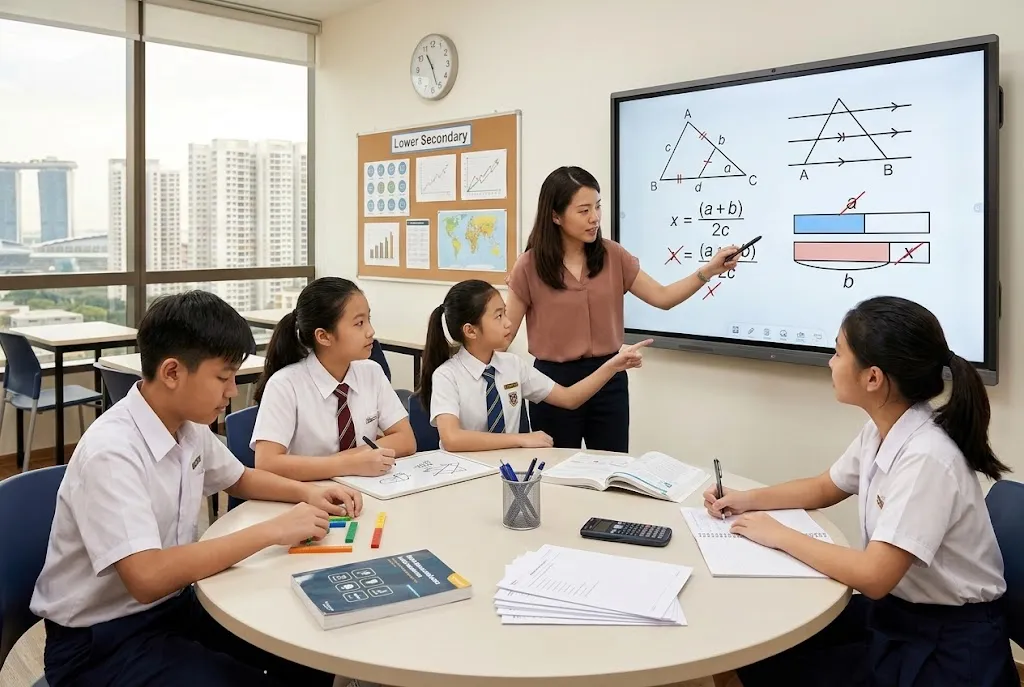
The transition from primary to secondary school introduces a significant change in how students learn mathematics. Questions become more analytical, concepts become more interconnected, and students are increasingly expected to explain their reasoning rather than simply apply familiar procedures. Therefore, lower secondary math tuition singapore can provide valuable support for students adapting to these new academic expectations.
At this stage, students encounter mathematical ideas that form the foundation for more advanced secondary topics. Strong understanding of numbers, algebra, geometry, ratios and mathematical reasoning can make later learning considerably easier. Consequently, timely support can help students address weaknesses before they become more difficult to overcome.
For parents, the objective should not simply be to increase the number of questions a child completes each week. Instead, effective tuition should develop conceptual understanding, accuracy, independent thinking and confidence.
Why Is Lower Secondary Mathematics More Challenging?
Secondary mathematics introduces a greater level of abstraction than students typically encounter in primary school. Instead of working mainly with numerical calculations, students begin using algebraic expressions, equations, mathematical relationships and formal notation more extensively.
As a result, students who previously relied heavily on memorised procedures may find the transition difficult. A question may require them to identify an underlying relationship before deciding which calculation to perform.
Furthermore, secondary mathematics builds progressively. A misunderstanding in an early topic can affect later concepts that depend upon it. Therefore, identifying and correcting learning gaps early can prevent students from carrying those difficulties into subsequent years.
What Does Lower Secondary Math Tuition Singapore Typically Cover?
A well-structured lower secondary math tuition singapore programme should complement what students learn in school while providing additional opportunities to practise and apply mathematical concepts.
Lessons may cover numerical operations, fractions, decimals, percentages, ratio, algebra, equations, geometry, statistics and other topics appropriate to the student’s school curriculum. However, the exact content can vary depending on whether the student follows the Singapore curriculum or an international programme.
More importantly, tuition should help students understand how different topics connect. For instance, algebraic reasoning can support problem-solving across several areas rather than remaining a topic that students study in isolation.
How Does Singapore Math Tuition for Primary and Secondary Differ?
Singapore Math Tuition for Primary and Secondary students needs to reflect the changing demands of each educational stage. Primary mathematics places considerable emphasis on developing numerical fluency, visualisation and structured problem-solving. Secondary mathematics gradually introduces greater abstraction and symbolic reasoning.
Consequently, teaching methods should evolve as students progress. A secondary student may need more emphasis on algebraic manipulation, mathematical notation and formal reasoning, whereas a primary student may benefit more from concrete representations and visual models.
This difference is particularly important when selecting tuition. A programme designed primarily around primary-level techniques may not provide sufficient preparation for the conceptual demands of secondary mathematics.
What Is the Lower Secondary Math Syllabus Singapore?
The lower secondary math syllabus singapore students follow depends on the curriculum offered by their school. Mainstream schools in Singapore follow the MOE Mathematics syllabus, while international schools may follow other frameworks, including Cambridge programmes.
The MOE lower secondary mathematics curriculum develops mathematical knowledge and processes progressively. Students encounter areas such as number and algebra, geometry and measurement, and statistics and probability, with mathematical reasoning and problem-solving integrated into learning.
Why Is Problem-Solving Important in Lower Secondary Mathematics?
Problem-solving remains central to mathematical development because students need to apply knowledge rather than simply recall formulas. A question may contain information that is irrelevant, require several steps or present a familiar concept in an unfamiliar format.
Therefore, students should learn how to interpret a question before beginning calculations. They can identify known information, determine what needs to be found and consider which mathematical relationships might be relevant.
Moreover, reviewing different solution methods can strengthen mathematical flexibility. When students understand why a method works, they become less dependent on memorising a single procedure and more capable of adapting to new problems.
How Can Lower Secondary Math Tuition Singapore Improve Student Confidence?
Confidence in mathematics often develops through repeated experiences of understanding and successfully applying concepts. When students consistently encounter questions they cannot solve, they may begin avoiding challenging tasks altogether.
A supportive tuition environment can provide a more controlled setting in which students can ask questions, make mistakes and receive immediate explanations. Gradually, this can make difficult topics feel more manageable.
Additionally, tutors can help students recognise progress beyond examination scores. Improved accuracy, better reasoning and greater independence are meaningful indicators that mathematical understanding is developing.
Should Students Use Cambridge Lower Secondary Checkpoint Past Papers Maths?
Students following the Cambridge Lower Secondary programme may encounter assessment materials associated with the Checkpoint framework. Cambridge lower secondary checkpoint past papers maths can be useful for understanding question styles and practising mathematical application when they are appropriate to the student’s curriculum and assessment objectives.
However, past papers should not replace conceptual learning. Students who attempt large numbers of examination questions without understanding the underlying mathematics may simply repeat the same mistakes.
Instead, past papers can be introduced after students have developed sufficient knowledge of the relevant topics. Tutors can then use incorrect answers as opportunities to identify gaps in reasoning and strengthen specific skills.
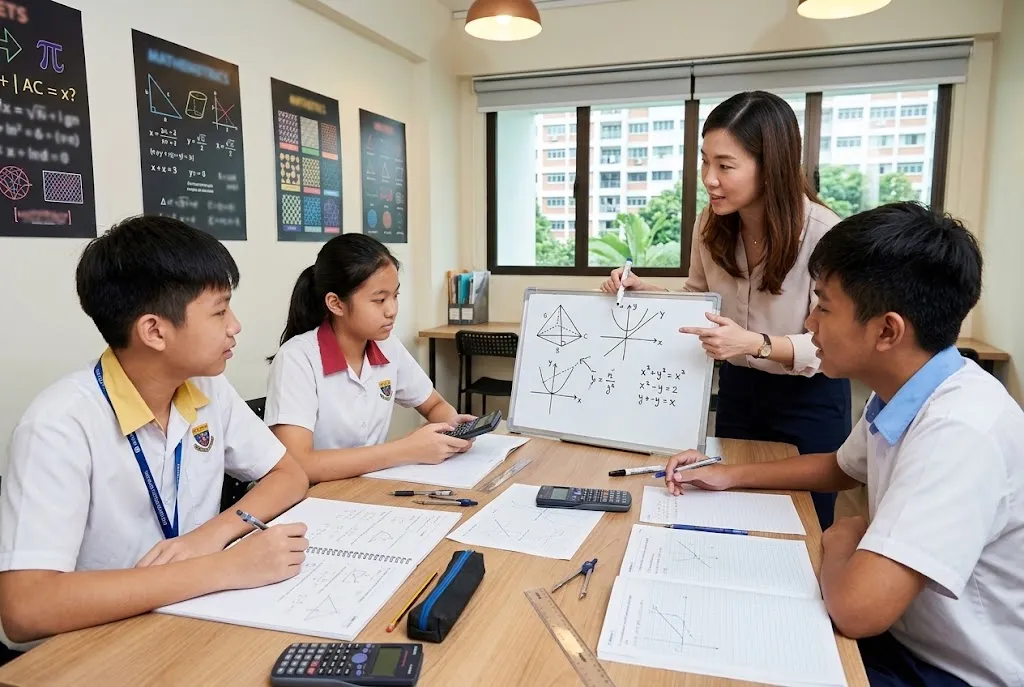
How to Choose Lower Secondary Math Tuition Singapore?
Class size, tutor experience and teaching approach should therefore be considered alongside location and fees. Smaller classes may provide more opportunities for interaction, whereas a larger programme may offer a different learning environment.
Parents should also ask whether the programme follows the student’s school curriculum. This is particularly important when comparing MOE and international-school programmes because their content sequence and assessment requirements may differ.
Can Lower Secondary Tuition Prepare Students for Future Mathematics?
The benefits of strong lower secondary foundations extend beyond immediate school examinations. Mathematics becomes increasingly interconnected as students progress, particularly when algebra, geometry and statistical concepts become more sophisticated.
Students who develop good habits at an early secondary level can therefore be better prepared for later academic demands. These habits include showing clear working, checking calculations, interpreting questions carefully and approaching unfamiliar problems systematically.
Furthermore, students who build confidence early may be more willing to engage with challenging mathematics later. This can become particularly valuable when they progress towards upper-secondary subjects and national examinations.
How Can Parents Support Mathematics Learning at Home?
Tuition is most effective when supported by consistent learning habits outside the classroom. Parents can encourage children to review difficult concepts, complete assigned practice and discuss mistakes rather than focusing exclusively on grades.
It is also helpful to create a realistic study routine. Short, consistent practice can be more sustainable than attempting large amounts of revision immediately before examinations.
Additionally, parents can encourage students to explain how they reached an answer. Explaining a solution in their own words can reveal whether the student understands the concept or has simply followed a memorised procedure.
How Can Students Prepare for Secondary Mathematics Examinations?
Effective examination preparation should begin with understanding rather than memorisation. Students should first ensure that they understand the concepts and methods included in their syllabus.
Once the foundations are secure, they can gradually introduce mixed-topic exercises and timed papers. This helps students practise switching between different mathematical concepts, which is often necessary during actual examinations.
Finally, students should analyse their mistakes. Categorising errors as conceptual misunderstandings, calculation mistakes, misinterpretations or careless errors can make revision more targeted and productive.
Why Is Consistent Tuition Better Than Last-Minute Revision?
Mathematics is cumulative, so leaving difficult topics unresolved can make future learning harder. Regular tuition provides opportunities to identify problems while there is still time to address them.
Consistent learning also gives students repeated exposure to mathematical reasoning. Instead of trying to remember an entire year’s content immediately before examinations, students can reinforce their understanding progressively.
Therefore, the value of tuition often comes from continuity rather than simply the number of hours spent studying. A manageable and consistent programme can create stronger long-term learning habits.
Why Choose Club Math?
Club Math provides mathematics tuition across primary, secondary and junior college levels, allowing students to continue with structured mathematics support as their academic requirements develop. Its programmes focus on conceptual understanding and problem-solving rather than examination practice alone.
For families looking for continuity, having primary and secondary mathematics programmes within the same tuition provider can simplify the transition between educational stages. The centre’s secondary programme is designed to support students with school mathematics while developing stronger problem-solving and examination skills.
Conclusion
Choosing lower secondary math tuition singapore should involve more than comparing tuition fees or selecting a centre based solely on popularity. The most valuable programme is one that matches the student’s curriculum, learning gaps, academic goals and preferred learning environment.
With appropriate support, students can strengthen mathematical foundations, become more confident with algebra and geometry, and develop the reasoning skills needed for increasingly complex questions. Most importantly, effective tuition should encourage students to understand mathematics independently so that the skills developed during lower secondary school continue to support their future academic progress.
Frequently Asked Questions
Students can begin tuition when they experience learning gaps, struggle with concepts or need additional preparation for secondary mathematics.
Yes. Strong students can benefit from challenging questions, deeper reasoning and opportunities to extend their mathematical understanding.
It commonly covers number, algebra, geometry, measurement, statistics and problem-solving according to the student’s curriculum.
Yes, when students follow the Cambridge curriculum and use relevant papers after building sufficient conceptual understanding.
Consider curriculum alignment, teaching quality, class size, tutor experience, location, learning support and the student’s individual requirements.