

How to Improve Math Skills in Singapore: Effective Learning Strategies

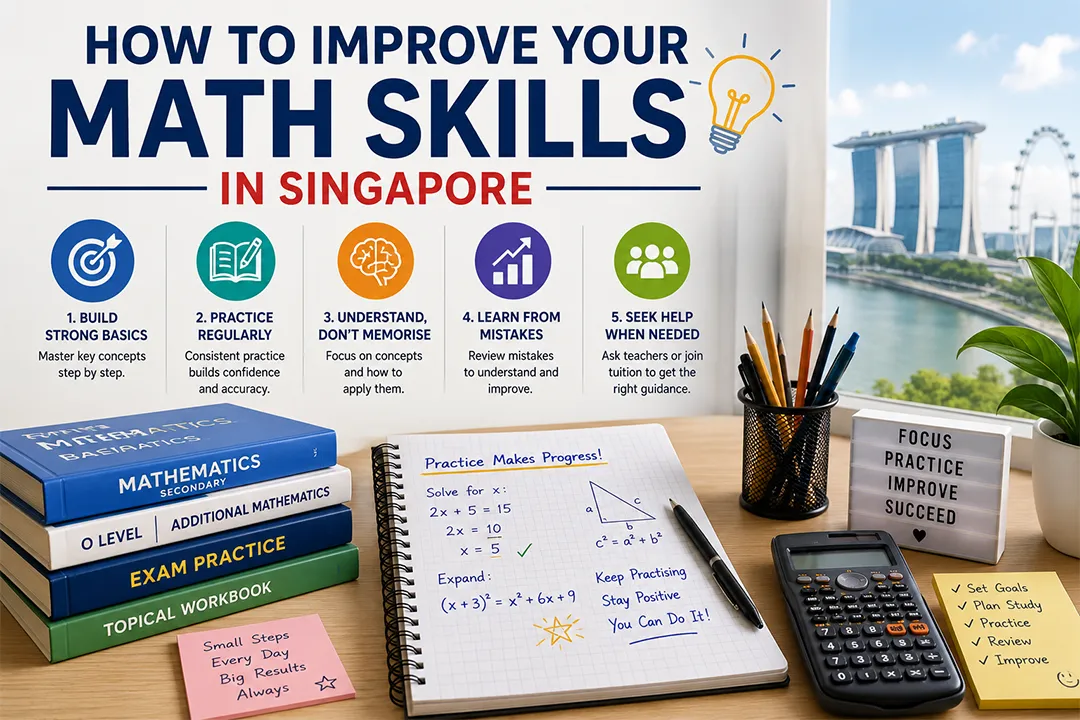
Mathematics requires more than memorising formulas and completing repetitive exercises. Students need to understand concepts, recognise patterns, apply logical reasoning, and communicate their solutions accurately. For students following the Singapore education system, developing these abilities can make a meaningful difference in classroom performance and examination preparation. Knowing How to Improve Your Math Skills in Singapore can therefore help learners approach mathematics with greater confidence and consistency.
Parents also have an important role in supporting mathematical development. A supportive learning environment, regular practice, appropriate resources, and encouragement can help children develop a healthier attitude towards mathematics. However, students should also gradually become independent learners who can select suitable strategies and evaluate their own progress.
What Is Singapore Math?
Singapore Math refers to an approach to mathematics education associated with Singapore’s curriculum. It places considerable emphasis on developing conceptual understanding, mathematical reasoning, and problem-solving rather than relying solely on memorisation. One recognised feature is the use of visual representations to help students understand relationships between quantities before moving towards more abstract mathematical notation.
The approach generally progresses from concrete experiences and visual representations towards abstract concepts. This progression can help learners understand why mathematical procedures work instead of simply remembering a sequence of steps. As students become more comfortable with the underlying concepts, they can gradually apply their knowledge to increasingly complex problems.
Singapore Math Curriculum
The Singapore Math curriculum is designed around mathematical concepts and problem-solving, with learning progressing systematically as students advance through their education. Students encounter foundational areas such as number, measurement, geometry, statistics, and algebra at different stages, with concepts becoming progressively more sophisticated.
A structured curriculum can help students establish connections between topics instead of treating every mathematical concept as an isolated skill. Consequently, learners who develop strong foundations in earlier topics may find it easier to understand more advanced concepts later. Consistent revision remains important, however, because mathematical knowledge becomes more useful when students can retrieve and apply it confidently.
How to Improve Math Accuracy and Problem-Solving Skills in Singapore
Accuracy and problem-solving are closely connected, but they require slightly different approaches. Accuracy improves when students carefully read questions, organise calculations, check units, and review their working. Problem-solving, meanwhile, requires students to interpret information, identify relationships, select an appropriate method, and determine whether the final answer makes sense.
Students can strengthen both abilities by slowing down during difficult questions rather than immediately searching for a solution. Writing each step clearly can make errors easier to identify. Furthermore, reviewing incorrect answers can be more valuable than simply moving on to the next exercise because mistakes often reveal gaps in understanding or weaknesses in a particular strategy.
Singapore Math Techniques for Parents and Students
Parents can support learning by encouraging children to explain how they reached an answer rather than immediately correcting mistakes. Asking questions such as “What information do you already know?” or “Is there another way to solve this?” can encourage independent reasoning without turning homework into a stressful experience.
At the same time, students should take responsibility for reviewing their own work. Keeping a record of recurring mistakes can help identify patterns, such as calculation errors, misunderstanding of terminology, poor time management, or difficulty selecting an appropriate method. Over time, this type of reflection can make study sessions more targeted and productive.
How Can Students Build Better Mathematical Foundations?
A strong foundation begins with mastering fundamental concepts before moving to increasingly difficult questions. Students who struggle with fractions, ratios, algebraic manipulation, or basic number relationships may find advanced topics unnecessarily difficult because later concepts often depend on earlier knowledge.
Therefore, students should address gaps instead of repeatedly practising questions they already understand. Short, focused revision sessions can be particularly useful for strengthening weaker areas. In addition, mixing familiar questions with moderately challenging problems can help students maintain confidence while gradually extending their abilities.
How Does Regular Practice Improve Math Skills?
Regular practice helps students become more familiar with mathematical concepts, question structures, and problem-solving techniques. However, effective practice should involve variety. Completing hundreds of nearly identical questions may improve speed for a particular procedure but may not adequately prepare students for unfamiliar problems.
Instead, students should combine routine exercises with application-based and higher-order questions. Reviewing solutions after each practice session can further improve learning because students can identify which steps were effective and which need refinement. Gradually, this process can improve both confidence and mathematical flexibility.
How Can Students Become More Confident in Mathematics?
Mathematical confidence develops when students understand the reasoning behind a solution and recognise that difficult questions can be approached systematically. Instead of viewing an incorrect answer as failure, learners can treat mistakes as opportunities to identify gaps and improve their methods.
Students can also build confidence by gradually increasing the difficulty of their practice. Starting with familiar concepts before attempting unfamiliar applications creates a stronger foundation. Moreover, explaining solutions aloud or writing complete working can reinforce understanding and make mathematical thinking more organised.
What Study Habits Can Improve Math Performance?
Effective study habits should prioritise consistency rather than last-minute revision. Short, focused sessions throughout the week can give students regular opportunities to revisit concepts, practise calculations, and identify areas that need additional attention. This approach can also reduce the pressure associated with intensive revision immediately before examinations.
Students should maintain organised notes and record recurring errors during practice. Reviewing these mistakes periodically can reveal whether difficulties arise from conceptual misunderstandings, careless calculations, or problems with interpreting questions. Consequently, revision becomes more targeted because students can spend more time addressing genuine weaknesses.
How Can Students Solve Difficult Math Problems More Effectively?
Difficult mathematical questions often become more manageable when students break them into smaller components. First, they should identify the information provided and determine exactly what the question requires. Next, they can consider diagrams, equations, tables, or other representations that may reveal relationships between the known and unknown quantities.
Students should also avoid committing to the first method that comes to mind. Considering whether another approach could produce the same result can strengthen mathematical flexibility. After reaching an answer, checking whether it is reasonable provides an additional opportunity to identify calculation or interpretation errors.
Common Mistakes That Can Limit Math Improvement
One common mistake is concentrating exclusively on memorising formulas without understanding when and why they should be applied. Although formula knowledge is useful, students also need to recognise the conditions under which a particular formula or method is appropriate. Otherwise, unfamiliar questions can become difficult even when the relevant formula has been memorised.
Another issue is avoiding challenging questions because they initially appear difficult. Regular exposure to unfamiliar problems can gradually improve resilience and strategic thinking. Students should also avoid rushing through calculations, as careless arithmetic and incomplete working can reduce otherwise strong performance.
Singapore Maths vs Cambridge Maths
Singapore Maths vs Cambridge Maths involves comparing educational approaches that can differ in curriculum structure, assessment emphasis, and progression. Singapore’s mathematics education places strong emphasis on conceptual understanding, mathematical problem-solving, and the development of reasoning skills within its national curriculum.
Cambridge mathematics programmes can have their own syllabus structures, assessment objectives, and examination requirements depending on the qualification. Therefore, students should compare the specific curriculum and assessment framework they are following rather than assuming that all Singapore and Cambridge mathematics programmes are identical.
For students preparing for examinations, understanding the exact syllabus is particularly important. Knowing which topics, skills, question types, and assessment requirements apply allows learners to focus their preparation more effectively.
How Can Parents Support Better Math Learning?
Parents can encourage mathematical development by creating a positive environment where children feel comfortable asking questions and making mistakes. Rather than focusing solely on marks, parents can ask children to explain their reasoning and discuss the strategies they used to reach an answer.
Practical activities can also provide opportunities to apply mathematics outside formal study sessions. Comparing prices, measuring ingredients, calculating distances, interpreting schedules, or working with simple budgets can demonstrate how mathematical concepts appear in everyday situations. These experiences can make learning more meaningful while encouraging children to recognise mathematics as a practical skill.
When Should Students Seek Additional Math Support?
Additional support can be useful when a student repeatedly struggles with particular concepts despite regular practice. Persistent difficulties may indicate a gap in foundational knowledge that needs to be addressed before the learner can progress confidently to more advanced topics.
Tuition or enrichment classes can provide structured guidance, targeted practice, and opportunities to ask questions in a focused learning environment. However, additional lessons work best when they complement independent study rather than replace it. Students should continue reviewing concepts, practising questions, and analysing their own mistakes between lessons.
Why Choose Club Math?
Club Math provides structured mathematics tuition for students seeking additional support with their mathematical learning. Its lessons can help learners strengthen conceptual understanding, practise problem-solving, and develop greater confidence when approaching challenging questions.
A focused learning environment can also give students opportunities to work through questions systematically and receive guidance when they encounter difficulties. By combining explanation, practice, and problem-solving, Club Math can support students who want to develop stronger mathematical foundations and prepare more effectively for their academic goals.
Conclusion
Knowing How to Improve Your Math Skills in Singapore involves developing more than calculation speed. Students need strong conceptual foundations, consistent practice, careful reasoning, accuracy, and the ability to apply mathematical knowledge to unfamiliar situations.
Singapore Math techniques can provide useful approaches for developing these abilities, particularly through visualisation, structured thinking, and problem-solving. At the same time, students should understand the specific curriculum and assessment requirements they follow. With purposeful practice, regular reflection, and appropriate support, learners can gradually become more accurate, confident, and capable mathematicians.
Frequently Asked Questions
The timeframe varies between students. Consistent practice over several weeks or months can gradually strengthen understanding, accuracy, confidence, and problem-solving ability.
Read questions carefully, write your working clearly, avoid rushing calculations, check units and signs, and review mistakes after completing practice questions.
Its emphasis on conceptual understanding and visual representation can help students understand relationships between mathematical quantities. However, the effectiveness depends on the learner’s individual needs and learning environment.
Accuracy should generally come first. Once students understand concepts and can solve questions reliably, repeated practice can gradually improve speed without sacrificing careful reasoning.
Well-structured tuition can provide additional explanation, guided practice, and exposure to different question types. Students gain the most benefit when they also practise independently and review their mistakes.