

A-Level Math Revision Plan: How to Prepare for JC2 Exams
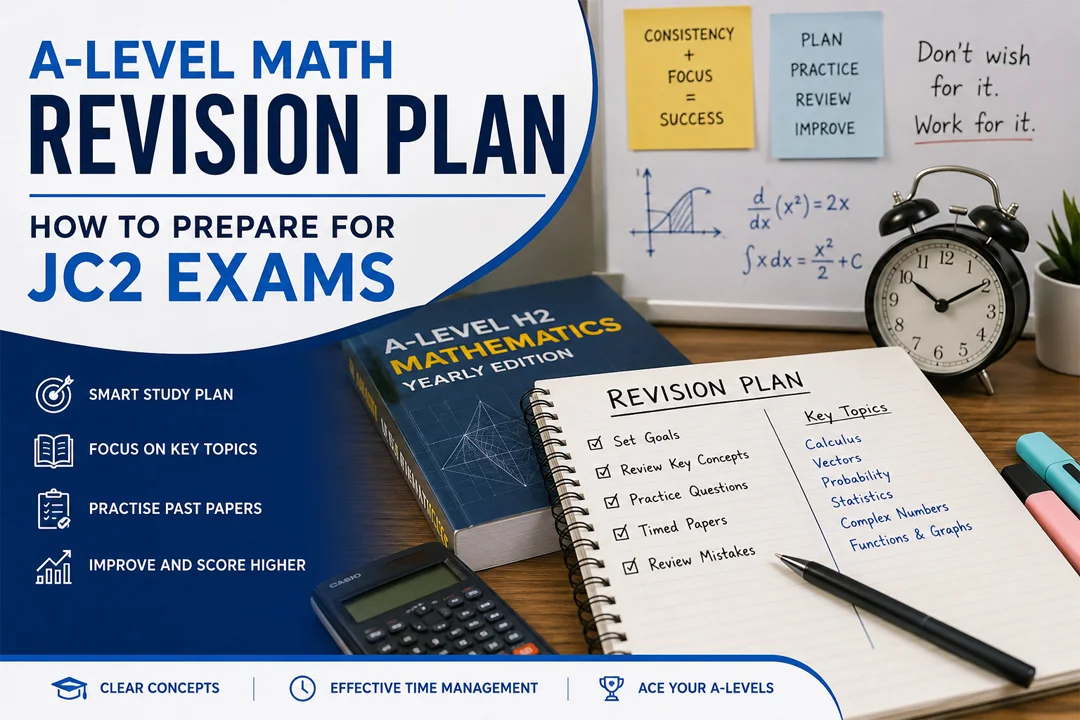
For many Junior College students in Singapore, H2 Mathematics is one of the most demanding subjects in the Singapore-Cambridge GCE A-Level examination. The syllabus covers a wide range of topics, from calculus and vectors to probability and statistics, requiring both conceptual understanding and strong problem-solving skills. As the A-Level examinations approach, many JC2 students find themselves overwhelmed by the amount of content they need to revise and the pressure of balancing multiple H2 subjects.
Having a structured A-Level Math revision plan can make a significant difference in your preparation. Rather than revising randomly or relying on last-minute cramming, a clear revision strategy helps you prioritise important topics, strengthen weak areas, and build confidence through consistent practice. In this guide, we will explore a practical H2 Math revision plan, study tips, revision schedules, and exam strategies to help you prepare effectively for your JC2 examinations.
Why JC2 Students Need a Structured A-Level Math Revision Plan
Preparing for H2 Mathematics requires more than simply studying harder. A structured revision plan helps JC2 students stay organised, prioritise important topics, and make steady progress towards their A-Level examination goals.
The Challenge of Managing Multiple H2 Subjects
Most JC2 students are preparing for several demanding subjects at the same time. Without a proper study plan, it is easy to spend too much time on familiar topics while neglecting areas that need more attention. This imbalance can create knowledge gaps and increase stress closer to the examination period.
Why Last-Minute Revision Rarely Works
Unlike subjects that rely heavily on memorisation, H2 Mathematics requires regular practice and application. Students who leave revision until the final few weeks often struggle to develop the problem-solving skills and exam techniques needed to perform well. Effective preparation requires consistent effort over an extended period.
Benefits of a Revision Schedule
A structured revision schedule helps students stay organised and monitor their progress. It ensures adequate time is allocated to concept review, question practice, and timed examinations while reducing unnecessary stress. Consistent revision also improves retention and allows students to address weaknesses before they become major obstacles.
Step 1: Assess Your Current H2 Math Performance

Before creating a revision strategy, it is important to understand your current strengths and weaknesses. Evaluating your performance allows you to focus on areas that need the most improvement and use your revision time more effectively.
Identify Strong and Weak Topics
The first step in any effective A-Level Math revision plan is understanding your current performance level. Review your recent tests, assignments, and school examination papers to identify topics that require additional attention. Common challenging areas include calculus, vectors, complex numbers, probability, and hypothesis testing. Categorising topics into strong, moderate, and weak areas allows you to create a more focused revision strategy.
Analyse Past Exam Papers
Past examination papers provide valuable insights into recurring mistakes and knowledge gaps. Instead of focusing only on grades, analyse why marks were lost. Determine whether errors resulted from weak concepts, careless mistakes, poor interpretation of questions, or time management issues. This process helps identify specific areas for improvement.
Create a Revision Priority List
After evaluating your performance, create a revision priority list. Weak topics should receive the highest attention, followed by moderate topics that require reinforcement. Strong topics should still be reviewed periodically to maintain confidence and prevent knowledge deterioration.
Step 2: Build a Weekly H2 Math Revision Schedule
A consistent study schedule helps transform revision into a manageable routine rather than a stressful task. By allocating time for concept review, practice questions, and timed papers, students can develop stronger mathematical skills while maintaining balance across other subjects.
Allocate Time for Concept Review
Concept review remains important throughout the revision process. Allocate dedicated weekly sessions to revisit key formulas, theories, and mathematical techniques. A strong understanding of concepts allows students to apply methods effectively when faced with unfamiliar examination questions.
Schedule Practice Questions Daily
Daily practice is one of the most effective H2 Math study tips. Regular exposure to different question types improves familiarity, speed, and accuracy. Even short daily practice sessions can help reinforce learning and strengthen problem-solving skills.
Include Weekly Timed Practices
Timed practice sessions help students develop examination discipline and improve time management. Completing selected sections or full papers under examination conditions builds confidence and prepares students for the pressure of the actual A-Level examinations.
Activity | Recommended Hours Per Week |
Content Review | 4 |
Topical Practice | 5 |
Timed Papers | 3 |
| Error Review | 2 |
Sample Weekly A-Level Math Revision Timetable
A structured timetable can help students maintain consistency throughout their revision period.
Day | Revision Focus |
Monday | Calculus Concept Review and Practice |
Tuesday | Probability and Statistics Questions |
Wednesday | Vectors and Complex Numbers |
Thursday | Timed Topical Practice |
Friday | Weak Topic Revision |
Saturday | Full H2 Math Practice Paper |
Sunday | Error Log Review and Formula Revision |
Step 3: Focus on High-Weightage H2 Math Topics
Not all topics carry the same importance during revision. While every topic in the H2 Mathematics syllabus matters, some areas appear more frequently and contribute significantly to overall examination performance.
Topic | Priority Level | Why It Matters |
Calculus | High | One of the largest components of H2 Math |
Probability & Statistics | High | Frequently tested across multiple question types |
Vectors | High | Commonly appears in examination papers |
Functions & Graphs | Medium-High | Supports understanding of calculus concepts |
Complex Numbers | Medium | Regularly tested through application questions |
Numerical Methods | Medium | Often follows predictable structures |
Calculus
Calculus is one of the most heavily tested topics in the H2 Mathematics syllabus. Students should focus on differentiation, integration, differential equations, and applications involving optimisation and rates of change. Strong calculus skills can significantly influence overall examination performance.
Probability and Statistics
Probability and statistics contribute a substantial portion of marks in the A-Level examination. Topics such as probability distributions, sampling, and hypothesis testing require both conceptual understanding and accurate interpretation.
Vectors
Vectors frequently appear in examination papers and often involve multi-step problem-solving. Students should develop confidence in vector equations, geometric interpretation, and applications involving lines and planes.
Functions and Graphs
Functions and graphing techniques form the foundation of many mathematical concepts. Understanding transformations, graph behaviour, and function properties supports learning across multiple H2 Mathematics topics.
Step 4: Use Past-Year Papers Effectively
Past-year papers are one of the most valuable resources for A-Level Math revision because they expose students to actual examination-style questions and common topic combinations. When used strategically, they help improve problem-solving skills, identify weak areas, and build the confidence needed to perform well in the Singapore-Cambridge GCE A-Level Mathematics examination.
Start with Topical Questions
Before attempting full papers, focus on topical practice to strengthen individual concepts. This approach allows students to target weak areas and build confidence gradually.
Progress to Full Papers
Once students have developed proficiency across most topics, they should begin attempting complete examination papers. Full papers help integrate concepts and prepare students for actual examination conditions.
Simulate Real Exam Conditions
To maximise the benefits of practice papers, complete them under realistic examination conditions without notes or external assistance. This provides a more accurate assessment of readiness and highlights areas that require further improvement.
Step 5: Maintain an Error Log Book
An error log book is a powerful tool for identifying recurring mistakes and tracking revision progress. Regularly reviewing errors helps students strengthen weak concepts, reduce careless mistakes, and avoid repeating the same problems during examinations.
Record Conceptual Mistakes
An error log book is one of the most effective revision tools available. Whenever you make a mistake, record the question, topic, and correct method. This helps identify recurring conceptual weaknesses and prevents the repetition of similar mistakes.
Track Careless Errors
Many students lose marks due to avoidable errors such as incorrect calculator inputs, sign mistakes, or misreading questions. Tracking these mistakes increases awareness and encourages greater accuracy.
Review Weekly
Set aside time each week to review your error log and attempt similar questions again. Consistent review transforms weaknesses into strengths and supports long-term improvement.
Step 6: Prepare for the Final 30 Days Before A-Levels
The final month before the A-Level examinations is critical. Students should focus on consolidating knowledge, refining exam techniques, and strengthening weaker topics.
Time Period | Revision Focus |
Days 30–21 | Complete topical revision and consolidate notes |
Days 20–11 | Attempt full timed papers and analyse mistakes |
Days 10–5 | Review weak topics and recurring errors |
Days 4–2 | Revise formulas, methods, and key concepts |
Day Before Exam | Light revision, confidence building, and adequate rest |
Students should avoid learning entirely new methods during the final week. Instead, focus on reinforcing existing knowledge and maintaining confidence.
A-Level Math Exam-Day Tips
Even with thorough preparation, exam-day performance plays a crucial role in achieving your target grade. Following effective examination strategies can help you manage time wisely, reduce unnecessary mistakes, and approach the paper with greater confidence.
- Start with Questions You Can Solve Confidently: Beginning with familiar questions helps secure marks early and builds confidence for the rest of the examination.
- Manage Your Time Carefully: Avoid spending excessive time on difficult questions. Move on when necessary and return later if time permits.
- Check Calculator Inputs: Always verify calculator settings and numerical inputs. Small calculator mistakes can lead to unnecessary mark losses.
- Leave Time for Final Review: Reserve a few minutes at the end of the paper to review calculations, working steps, and final answers.
Common H2 Math Revision Mistakes to Avoid

Many students work hard but do not always revise effectively. Understanding the most common revision mistakes can help you avoid wasted effort, improve study efficiency, and achieve better results in the A-Level Mathematics examination.
Reading Notes Without Practice
Many students spend hours reading notes but complete very few questions. Mathematics is a skill-based subject that requires active practice and application.
Ignoring Weak Topics
Students often prefer revising topics they already understand. However, addressing weak areas early provides greater opportunities for improvement and confidence building.
Doing Papers Without Reviewing Mistakes
Completing numerous papers without analysing mistakes limits improvement. The review process is where students identify misconceptions and refine their problem-solving techniques.
Memorising Instead of Understanding
Memorisation alone is often insufficient for H2 Mathematics. Students should focus on understanding concepts and applying them in different situations rather than relying solely on memorised procedures.
A-Level Math Revision Checklist for JC2 Students
- Understand all major H2 Math syllabus topics.
- Complete topical revision for weak areas.
- Finish at least 10–15 timed practice papers.
- Maintain and review an error log book weekly.
- Revise key formulas and applications.
- Practise calculator techniques.
- Improve examination time management.
- Review common mistakes regularly.
- Strengthen high-weightage topics.
- Complete a final revision cycle before the examinations.
Final Thoughts
Preparing for the Singapore-Cambridge GCE A-Level Mathematics examination requires more than simply memorising formulas or completing practice papers. Success comes from following a structured A-Level Math revision plan, identifying weaknesses early, practising consistently, and learning from mistakes. Students who combine strong conceptual understanding with effective examination techniques are often better positioned to achieve their academic goals.
The key to successful JC2 exam preparation is consistency. Small, regular revision sessions completed over several months are often more effective than last-minute cramming. By following a clear revision strategy, prioritising high-weightage topics, and reviewing mistakes carefully, students can approach the A-Level examinations with greater confidence and readiness.
At Club Math, our JC Math Tuition programmes help students strengthen concepts, improve problem-solving skills, and master examination techniques. With structured guidance and targeted practice, students can build the confidence needed to excel in H2 Mathematics and achieve their desired A-Level results.
Frequently Asked Questions
Students should ideally begin structured revision several months before their preliminary examinations. Starting early allows sufficient time for concept review, practice, and improvement.
Most students benefit from spending approximately 10 to 15 hours per week on H2 Mathematics revision, depending on their current proficiency and target grade.
Many high-performing students complete between 10 and 20 full examination papers, including school preliminary papers from various Singapore Junior Colleges.
Yes. Consistent revision, targeted practice, effective error analysis, and strong examination techniques can lead to significant grade improvements over time.